





The question that really decides the purchase of a post driver is rarely which model to choose. It is how many working days it takes for the machine to pay for itself.
It has a numerical answer, and it depends on three figures of your own: how many posts you drive a year, what an hour of labour costs you and the ground you work on. Here is the full calculation, with an example, so you can do it with your own numbers.
How many posts you drive by hand in a day, and at what cost
Driving posts with a sledgehammer is a two-person job. One holds the post and keeps it plumb, the other swings, and they take turns because nobody lasts a full day swinging above head height. That detail is the one usually left out of the calculation: cost per post is not worked out with one wage, but with two.
The calculation: wages, hours and posts per hour
The formula is short:
Cost per post = (hourly labour cost × number of people) ÷ posts driven per hour
All three figures are yours. The one that varies most is the third, posts per hour; that is why, further down, the calculation is also done per full working day, which does not depend on it.
For the example we use sample figures, which you should replace with your own: labour at €15 per hour per person, two people working and 12 posts driven per hour between them. Driving works out at €2.50 per post. Over an 8-hour day, about 96 posts and €240 in labour.
The costs nobody counts: the broken post and the split head
On top of the labour bill come three items that hardly ever appear in the budget:
- The split head. The sledgehammer blow crushes the top of the timber. Water gets in through a split head, and a post that takes in water rots sooner. You do not pay for it today: you pay when it has to be replaced.
- The leaning post. If the post goes off line, it has to be pulled out and started again. That post usually ends up discarded, and the work of driving it has been paid for twice.
- The drop in output. Posts in the last hour of the afternoon are not driven at the pace of those first thing in the morning, nor as straight. Fatigue is a cost, even if there is no invoice for it.
If posts are discarded on your farm, that percentage, applied to what each post costs you, is money being lost today without anyone seeing it.
The same job with a petrol post driver
With a stake and post driver running on petrol, the work changes in something more important than speed: it becomes a one-person job. Whoever held the post is free for another task, and that halves the multiplier in the formula.
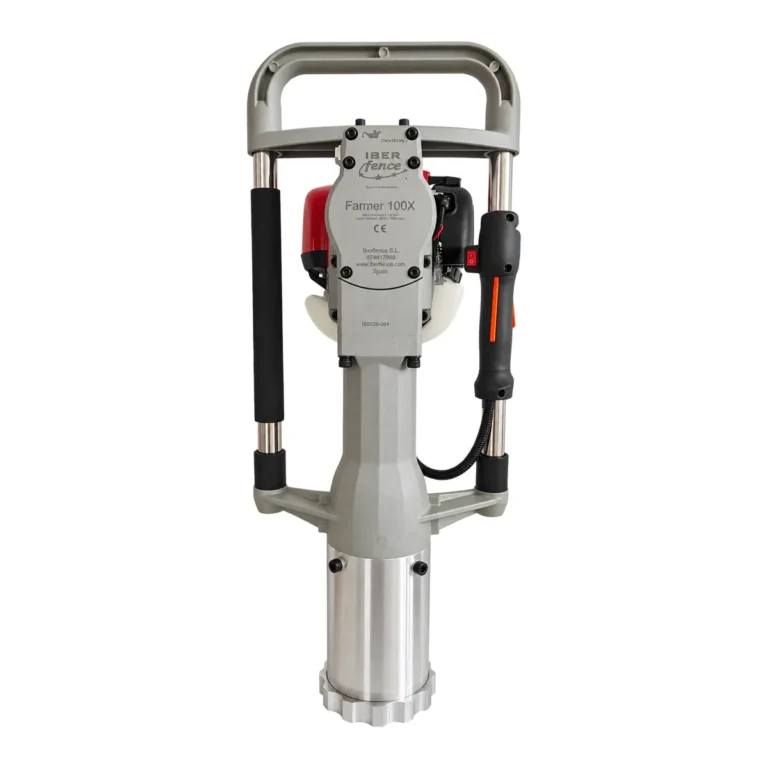
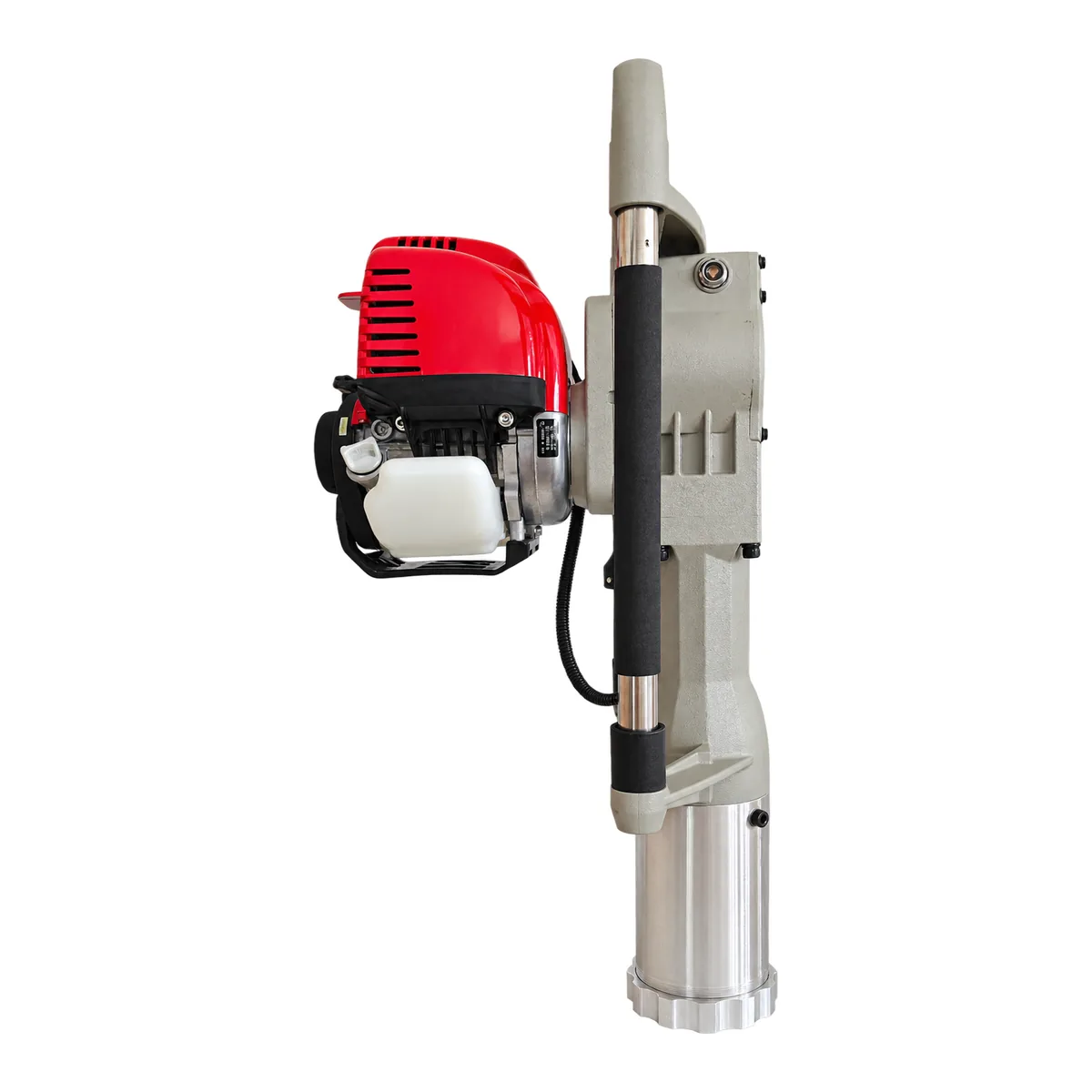
The Farmer 100X weighs 18.80 kg and strikes 1,500 to 2,200 times per minute, with an impact energy of 43.3 to 58 joules depending on the engine. That frequency is why one person gets ahead with the work: the post goes down through an accumulation of rapid blows, not through the force of each one.
Where it shows most is with posts that resist by hand. Acacia is the typical case: a dense, sinewy timber that lasts very well in the ground, which is why it is so widely used in vineyards and livestock fencing, but driving it with a sledgehammer punishes the head of the post and the person swinging. With rapid blows, the post goes in through accumulation and the head arrives intact.
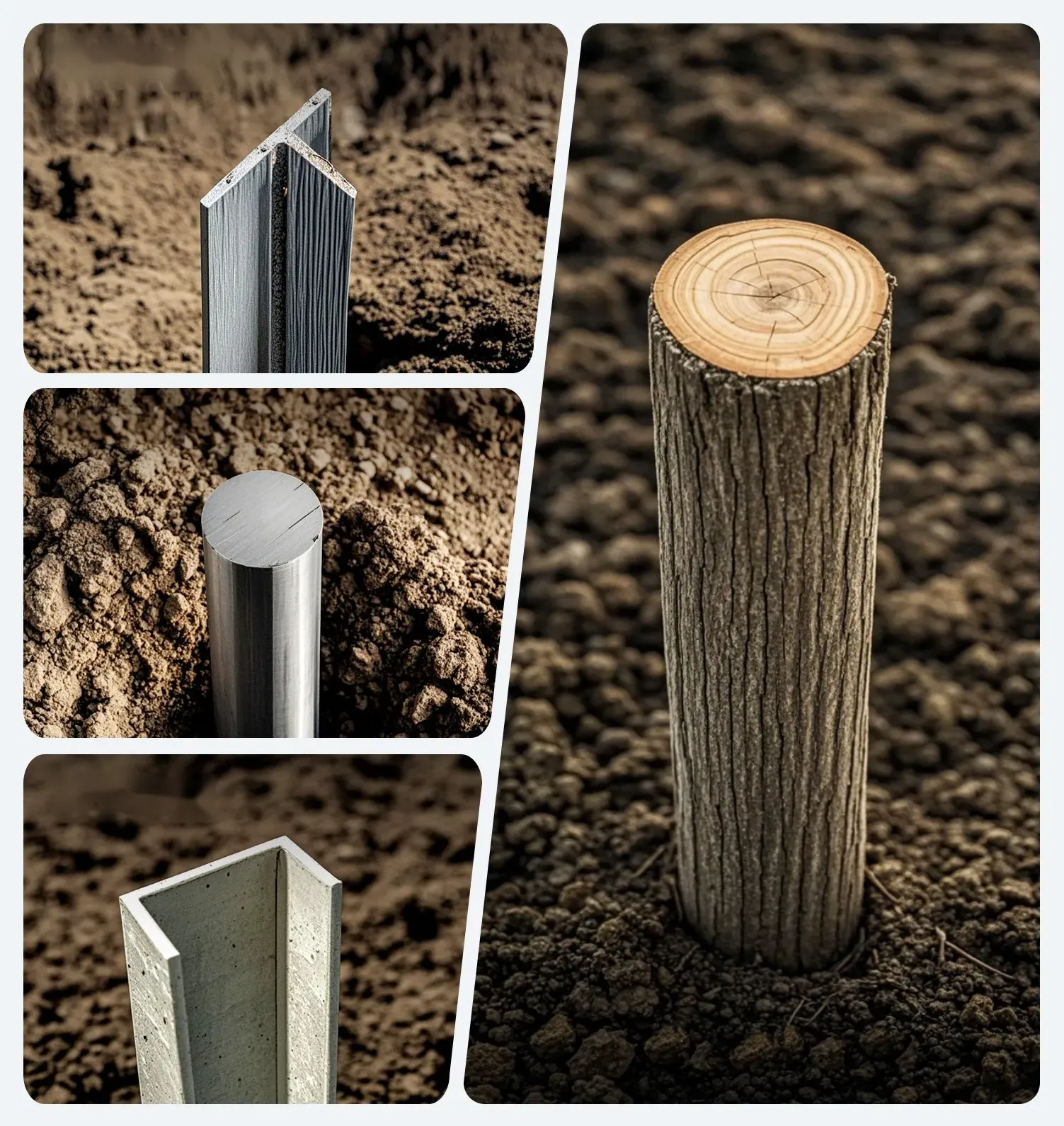
And not just timber: the Farmer 100X drives any post that fits its nozzle, whether metal, timber, plastic or PVC, such as the L-shaped iron posts common in fencing and perimeter protection. The included adapters are changed without screws or additional tools: unscrew the collar, fit the adapter and screw it back on.
The calculation is the same, with two new variables: fuel and the payback of the machine.
Output by ground type
Output depends on the ground you usually work on:
- Loose or cultivated soil. The post goes in without resistance, and the pace is set by the time taken to position and plumb it, not to drive it.
- Compact soil or dry clay. This is where the striking frequency makes the biggest difference over the sledgehammer. Check the depth reached on the first posts.
- Ground with small stones. The rapid blows push small stones aside and the post advances without prior digging.
In every case, the machine needs one person; the sledgehammer, two.
Fuel consumption per day
For the example, with the Iberfence IBF-37 engine, we take the maximum consumption given on the Farmer 100X product page: 0.71 litres per hour. Over an eight-hour day that is about 5.7 litres; at €1.60 a litre, just over €9 of petrol a day. It is the item most overestimated before buying and the one that weighs least afterwards: around 7% of the cost of a day with the machine, while the remaining 93% is the person operating it. Use 92-octane petrol or higher.
The break-even point: how many days it takes for the machine to pay for itself
The soundest way to do the calculation does not depend on how many posts you drive per hour: it compares the cost of a full working day. By hand you need two people; with the machine, one. It is enough for the operator with the machine to drive at least as many posts as the pair with the sledgehammer:
Days to pay back = machine price ÷ (cost of a day by hand − cost of a day with the machine)
Using the earlier example, a day by hand costs €240: two people at €15 an hour for eight hours. A day with the machine costs €120 for one person plus about €9 of petrol, that is, €129. The difference in favour of the machine is about €111 per day. The wage and fuel price are assumptions: replace them with your own.
Example with the Farmer 100X and Iberfence IBF-37 engine
The Farmer 100X post driver is manufactured by Iberfence. With the price published on its product page for the version with the Iberfence IBF-37 engine and a saving of €111 per day, the machine has paid for itself in fewer than ten working days. From then on, every day is a saving.
With Honda GX35T or GX50T engine
With a Honda engine, the break-even point is around twelve working days:
| Engine | Days to pay back* |
|---|---|
| Iberfence IBF-37 | ≈ 9.5 |
| Honda GX35T | ≈ 11.7 |
| Honda GX50T | ≈ 12.2 |
* With the price excluding VAT published on the product page and the example saving of €111 per day. With your own figures, the result changes.
The difference between engines is not only price: the impact energy, from 43.3 to 58 joules, depends on the engine. With the saving in the example, the price difference from the IBF-37 to the GX35T is recovered in just over two days, and from the GX35T to the GX50T in less than half a day. Versions with a Honda engine also have a Honda service network available in practically every market. For less intensive use, the version with the IBF-37 engine is the lowest investment.
Getting the most from the machine from the first day
The payback in the example holds with three simple habits:
- The right model for the post. The Farmer 80X stake and post driver works with stakes and posts from 20 to 80 mm; the IBF-82X PRO, from 20 to 82 mm; and the Farmer 100X, from 20 to 100 mm as standard and up to 120 mm with the optional adapter.
- Maintenance as set out in the manual. The maintenance kit contains the complete set of seals and EP0 grease, and you can carry out the maintenance yourself by following your machine's instruction manual. We recommend replacing all the seals once a year, or sooner if you notice reduced performance.
- More jobs, more working days. The same machine is used for farm and livestock fencing, vineyards, fruit and vegetable plantations and greenhouses, stakes in parks, nurseries and forestry, foundation and anchoring micropiles, pegs for large marquees and tents, and perimeter protection on roads and hunting grounds. Every extra working day shortens the payback period.
Iberfence offers its own after-sales service, and in the shop you will find, with published prices, spare parts for the Honda GX35 engine and engines for post drivers.
What to check when choosing your post driver
Post diameter and stake length
Measure the diameter of the posts you normally use, including corner and strainer posts, which are usually thicker. The Farmer 100X takes up to 100 mm as standard, with the nozzle supplied in the case, and 120 mm with the optional adapter. If your corner posts are over 100 mm, choose the version with the 120 mm adapter when you buy the machine: bought with the post driver, it costs less than separately.
If you will be driving long stakes or working at height, the IBF-82X PRO accepts optional extensions.
The Farmer 100X comes with the 100 mm nozzle and 45, 60 and 78 mm adapters, plus the carry case and maintenance tools. For the usual diameters there are no accessories to add to the price.

EC Declaration of Conformity and the documents that must come with the machine
Every machine placed in service in the European Union must be supplied with its EC Declaration of Conformity and its instruction manual. Iberfence post drivers have an EC Declaration of Conformity. Keep your machine's documents: they support you in an inspection and in any warranty claim.
In short
By hand, every post costs two wages; with a post driver, one. In the example, the Farmer 100X with IBF-37 engine pays for itself in fewer than ten working days, and from then on every day is a saving, not counting the posts that are no longer discarded.
Choose the model by the diameter of your posts in the post drivers category. If you are unsure between models or engines, ask for advice using the form on our home page, giving the diameters you use and the type of ground. We serve private customers, businesses and professionals.
Warranty: 3 years for private customers and 1 year for businesses and professionals (see conditions).
Post driver distribution programme
We are expanding our distribution network in Europe and Latin America.

 We will be glad to help you with any question or project. At Iberfence we will get back to you within 24 to 48 hours.